

Early in my career, I rejoined an agency that was reinventing itself as a 360-degree shop. To raise the creative bar, they brought in a Chief Creative Officer who was one of the most inspirational people I’ve ever worked for. He, in turn, brought in people he trusted — including a Creative Director who had worked at virtually every high-end shop imaginable. He became my CD, and on some projects, my partner. Immensely talented, full of ideas, easy to be friends with. An ideal creative partner, really.
One day, an account person from another team stopped us mid-conversation and asked if we’d step in on a project that wasn’t going well. My CD surprised me by saying, “Of course. We’d love to help.”
That surprised me, because by that point in my career I’d noticed that every agency had two kinds of accounts.
There were the cool kids’ accounts. These were the ones every creative was clawing to get their hands on, because that’s where the great work happened. Then there were the just-get-it-done accounts. These were the ones that paid the bills but rarely inspired anyone. The client might be holding back the work. The brand might be a mess. The product might be boring. The project itself might not be up to par. Whatever the reason, the cool kids avoided these accounts like a bad review, terrified of what working on them might do to their personal brand.
So why did my CD say yes?
He told us a story that changed the way I thought about the business.
He was working late at the agency one evening when a frantic account person burst into his office looking for a team that had already left for the day. She had a problem: a set of tiny newspaper ads for a camera brand. You can think of this as a modern-day 300×250 banner, but in print, which needed headlines and a visual. They were due that day.
He said, “No worries. I can help.”
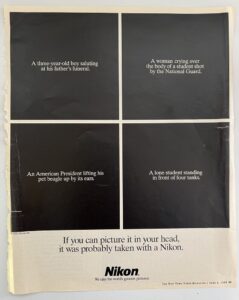
He sat down and started writing lines. Then something clicked. I don’t need a visual. He had access to the most powerful visual tool ever invented: the human imagination. He wrote reversed-out headlines that had bold, image-conjuring lines that sat proudly on a black background. No photo. Just words that made you see something.
The client was blown away. What started as a small, throwaway newspaper ad turned into a major campaign. The line? “If you can picture it in your head, it was probably taken with a Nikon.” One execution read: “A three-year-old boy saluting at his father’s funeral” — a direct reference to the iconic image of JFK’s son at the President’s funeral. Powerful. Dramatic. Gut-punch effective.
The campaign ran in 1991, won numerous awards, and appeared in that year’s Communication Arts Annual. The writer was Richard Kelley. The agency was Scali McCabe Sloves, New York.
I practically wore out the pages of that CA issue. The idea that words alone could conjure an image that powerful was amazing. A great line could do the work of a photograph, and that hit me like a freight train. It was one of the reasons I went into advertising.
And it almost didn’t happen. It came down to one person willing to stay late and say yes.
That lesson followed me for years.
On countless accounts that weren’t the darlings of the agency, I raised my hand. And many times, I was able to do breakthrough work. I broke through with work that made a real impact for clients who were starved for success. I wasn’t always successful. But when it worked, it was genuinely remarkable. The kind of work that could take a barely-there brand and turn it into a cultural touchstone.
FreeCreditReport.com, I’m looking at you.
To be clear, a thousand things can get between a creative person and a successful campaign, including the mental state of the creatives themselves. That’s what a great Creative Director is supposed to fix. Clear the runway. Empower the team. Inspire. Give the ideas a fighting chance to get off the ground.
And when the runway is clear, and the client is with you?
Not much can hold you back.
Randall Hooker
Executive Creative Director | Founder
Atomico Creative